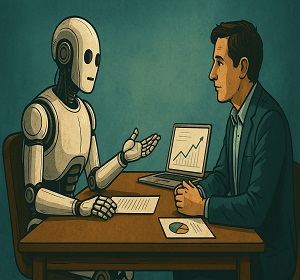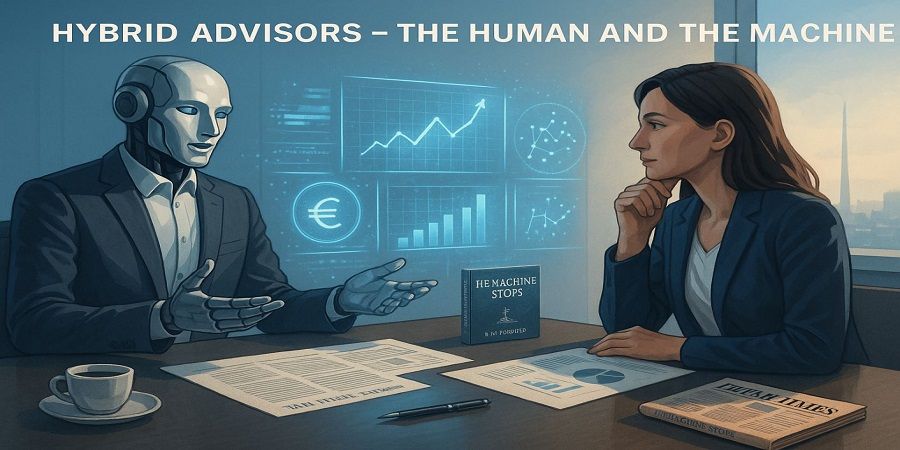

In a softly lit Dublin apartment late one evening, an investor sits before a glowing screen. She doesn’t dial an advisor or shuffle through paperwork; instead, she entrusts her savings to a few taps on a robo-advisor app. In return, the Machine, an algorithm in the cloud, allocates her money across funds and ETFs, rebalancing and optimising with quiet precision. It is convenient, almost comforting. Over a century ago, E.M. Forster imagined a world not unlike this: humans living underground in isolation, all needs met by an omnipotent Machine. In The Machine Stops (1909), Forster warned of a society so reliant on technology that people shunned direct experience, until the day “the Machine” failed and forced them to remember their humanity. Now, as Ireland hurtles toward a high-tech financial future dominated by robo-advisors, one cannot help but hear echoes of Forster’s cautionary tale. The robots are coming for finance, but at what human cost?
They go by friendly names, robo-advisor, digital advisor, automated investment platform, but their premise is the same: harness algorithms and artificial intelligence to do what human financial advisers have long done. “Robo-advisor services are about utilising and applying technology in the context of financial decision making,” explains Dr. Philip O’Reilly, a digital business expert at University College Cork. Instead of sitting across from a besuited advisor in a bank, customers answer an online questionnaire about their goals and risk appetite. The robo-advisor’s software then “trawl[s] across the entire market digitally to find the best options” and constructs a portfolio, usually of low-cost index funds. Through a simple mobile app interface, it becomes possible for anyone, even with modest sums, to invest with a few clicks.
Ireland is no stranger to this fintech revolution. In fact, Irish consumers have been among the quickest adopters of digital finance. Between 2017 and 2019, Ireland’s fintech usage rate soared from 26% to 71%, making it one of the world’s leading markets for fintech adoption (the global average in 2019 was 66%). In 2024 it’s still at approximately 71% in Ireland, still surpassing the global average. This openness to innovation laid the groundwork for robo-advisory services to gain a foothold. Back in 2016, Dublin-based startup Moneycube launched as an online platform to “make investments and pensions easy, transparent and profitable” for ordinary people. Moneycube’s co-founders, Irish professionals returning from careers abroad, saw that people at home were “missing out on new ways to build their savings” and aimed to “bring some of that knowledge home to Ireland, especially the use of technology”, as co-founder Ralph Benson put it. In other words, they set out to introduce Ireland to its first taste of the robo-advice ethos.
They were not alone for long. International players soon landed on Ireland’s shores. In early 2017, London-based ETFmatic opened its robo-investing service to Irish customers, touting minimum investments as low as €100 and annual fees starting at 0.3%. Around the same time, global giants like Vanguard and BlackRock were rolling out robo platforms abroad, signalling that this technology was moving from fringe fintech into the financial mainstream. “It was only a matter of time before robo-advisers were introduced to Ireland,” remarked Steven Barrett, a Dublin financial planner, back in 2017. Indeed, by the late 2010s, robo-advice was no longer a Silicon Valley experiment; it was a worldwide trend. Consulting firm AT Kearney projected that robo-advisors would manage over $2 trillion in assets within a few years. Irish banks and incumbents took notice. In 2018, Bank of Ireland partnered with fintech firm Ignition to launch a hybrid digital advice platform, with BoI’s wealth director Seán Ó Murchú heralding “a single, digital advice platform [that] will have a transformational impact on the Irish market”. Even global fintech super-apps entered the fray: in 2024, Revolut, which counts over 35 million users globally, launched its own robo-advisor service in Ireland, letting customers invest on autopilot with as little as €100 to start. “Built to make investing more accessible,” said Rolandas Juteika, Revolut’s head of wealth for Europe, “we want to give our customers the ability to make their money work for them in… a tailored and stress-free solution.” He noted that 53% of surveyed customers “simply don’t know where to start when it comes to investing”, exactly the hesitancy robo-advisors aim to overcome.
The appeal of these digital advisers is undeniable. Cost and convenience are their twin selling points. By automating portfolio management, robo-advisors dramatically cut down on fees that traditional advisors and active fund managers charge. For example, ETFmatic’s all-in fees range around 0.4–0.8% a year, a fraction of typical mutual fund costs, meaning an average investor “could save a ‘life-changing’ amount of money, ‘hundreds of thousands’, over a 30-year period,” the firm claimed. Just as importantly, digital platforms lower the barriers to entry. Investing used to require sizeable sums and navigating complex paperwork; now, a new investor can begin with a few hundred euro and no prior experience. “It’s never been easier to start small,” notes Moneycube, pointing out that technology has opened the door for investing with as little as a few hundred euro, something unthinkable in the past. Robo-advisors also appeal to those who find traditional finance intimidating or inaccessible. With user-friendly apps and no need for appointments or jargon-filled consultations, the process is demystified. It’s not just tech-savvy millennials who appreciate this, either. Ireland’s looming pension funding challenges are pushing even older generations to look for efficient ways to grow their money. As Dr. O’Reilly observes, people nearing retirement are becoming more conscious of where and how to invest, especially as they shoulder more responsibility for their pension pots in today’s self-managed retirement world. For a time-pressed, “cash‑strapped” younger demographic and a cost-conscious older generation alike, the idea of an ever-attentive machine handling one’s investments is highly attractive.
But for all the enthusiasm, a nagging question grows louder: what do we lose when we gain this convenience? The rise of the robo-advisor carries not just opportunities but subtle human costs that Ireland’s investors and institutions are now beginning to reckon with. In Forster’s story, people worshipped the Machine and forgot how to live without it. While trusting a robo-advisor with your ISA or pension is hardly science fiction dystopia, experts warn that over-reliance on algorithms can carry risks of its own.
One immediate concern is the loss of the human touch in financial advice. A seasoned advisor does more than crunch numbers; often they act as mentor, coach, even therapist through the emotional rollercoaster of investing. “Human beings need human beings,” as Mary Erdoes, one of JPMorgan’s top asset managers, succinctly put it. In turbulent markets or personal crises, having an empathetic human advisor can make the difference between wise patience and panic-selling everything. “There is a lot a client will tell you over the course of a meeting that they will not disclose when answering questions online, simply because there is no rapport with a computer,” notes Steven Barrett, the Dublin financial planner. A dropdown menu can’t detect hesitation in your voice or probe gently when you’re uncertain about your goals. By design, robo-advisors ask standardised questions, and they don’t always ask the right follow-up questions if your situation is out of the ordinary. As a result, nuances of one’s personal circumstances might be missed. “Not all algorithms are equal,” Dr. O’Reilly reminds us, cautioning that different robo platforms operate on different assumptions and can yield different recommendations. Without a human advisor to interpret and explain these nuances, investors must trust that the Machine’s black-box logic truly has their best interests at heart.
There is also the psychological cost. Investing can be an emotional journey, greed, fear, exuberance and despair all play into how people handle their money. Robo-advisors pride themselves on removing emotion from the equation (an algorithm doesn’t panic-sell in a crash or fall in love with a trendy stock). Yet, there’s a flip side: a machine may not be able to talk an anxious investor off the ledge during a market freefall. In a severe downturn or a sudden personal financial need, investors relying solely on an app might find themselves isolated with their fears. The Central Bank of Ireland has noted “there are risks, as well as advantages, for consumers from the greater use of technology to deliver financial products and services”, urging vigilance that innovation doesn’t outpace consumer protection. One risk is that less-knowledgeable investors could end up in unsuitable investments because they ticked the wrong box on a questionnaire. U.S. regulators have already queried whether robo-advisors’ risk profiling algorithms are “sufficiently detailed and rigorous” to truly match users with the right investments. If the algorithm misjudges someone’s risk tolerance, there is no wise elder advisor in the room to sense that disconnect and correct course.
Even more troubling is the issue of accountability. When you receive bad advice from a human financial advisor, you know who is answerable (and in many cases, you have legal recourse). But if a robo-advisor’s portfolio allocation performs poorly or, worse, malfunctions, who do you blame? In many automated platforms, the onus technically falls on the user: after all, the software only provided “information” based on your inputs, not personalised advice, a fine line that could leave consumers in a bind. Consumer advocates worry that people might not fully grasp this distinction and could be left high and dry in a worst-case scenario. Regulators are watching these platforms closely and have flagged a checklist of concerns: ensuring that automated tools don’t make misleading claims, that they recommend suitable products for each user, and that cybersecurity safeguards are ironclad, among others. A notable worry is “herding risk”, if thousands of investors in a market are funnelled by similar algorithms into the same few assets, a single market shock could hurt all of them in one blow. When everyone is plugged into the same Machine, the failures, however rare, can become systemic.
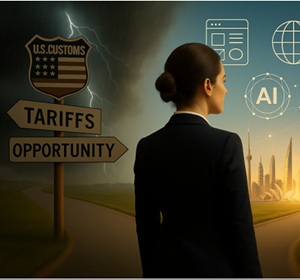
And then there’s the human cost in a more literal sense: jobs and skills. As financial institutions embrace automation, we’ve already seen early signs of displacement. In the UK, one major bank (RBS) made headlines a few years back by replacing 220 human advisors with a robo-advice system, aiming to cut costs and serve more customers with smaller balances. While Irish banks have so far taken a more blended approach, it’s clear that a fully digital advisory model could reduce the need for junior financial advisers, support staff, and brick-and-mortar advisory offices over time. The “transformational impact” of digital platforms, to use Bank of Ireland’s term, may indeed transform careers as well. This raises tough questions: Are we prepared for a future where aspiring financial planners must compete with AI for relevance? What happens to the craft of personalised financial planning when an algorithm handles most portfolios? As Vashti discovered in Forster’s The Machine Stops, over-dependence on a machine can atrophy human capabilities. While the context is different, the analogy resonates, if we slowly forget how to guide clients through financial decisions because “the Machine” does it all, we might lose more than just jobs; we could lose collective financial wisdom and the human relationships that pass it on.
End of Part 1 -
Coming in Part 2 : A Hybrid Future: Man and Machine.
Sources: