“What a waste of 3 precious hours of our time and don’t even start me on the amount of time we spent getting the board pack ready when it’s clear some board directors didn’t review it properly”. This was a lament of a senior executive in an interview in a recent board evaluation I was conducting. I had actually observed the board meeting the day before, was quite underwhelmed and so I asked the executive why he was so disappointed with the value-add of the board meeting. “We are on our knees right now in terms of serious market headwinds and threats to our business model. While we have highly experienced non-executive directors, they bring no real value to the table, no new thinking and we never feel stretched by them in a way that helps us improve our thinking and decision-making. For sure, they would intervene if we were driving the company off the cliff-edge but other than that, while they were all previously highly experienced executives, they don’t seem to grasp that the executive team really need their help and support.”
While the governance and oversight role and responsibilities of the board and non-executive directors (NEDs) will always get the spotlight, the role and responsibility to help and support the CEO and executive team often doesn’t get the attention it deserves. Right now, even the most capable CEOs and executive teams are struggling to navigate successfully through the white water rapids of un-precedented headwinds and challenges such as geo-political instability, AI, changing customer requirements and serious risks to long-standing business models. Over the last 10 years of evaluating boards, the thing that has most impressed me with high-performing boards is their ability to balance intelligent robust challenge, debate, oversight and holding the executive team’s feet to the fire with incredible levels of encouragement, support and added value to an executive team.
In our board evaluation process, we interview all of the executives who engage regularly with the board. It’s always fascinating to see the wide spectrum of responses when I ask the searching questions on the quality of the board’s challenge, oversight, support and value-add. In the case of a high-performing board, there is invariably a set of responses along the lines of; “They simply make us better as an executive team”, “They drive us crazy a lot of the time but we don’t mind as they work incredibly hard to add a lot of value while not being shy about hauling us over the coals on performance ….” and “I’m always nervous before board meetings as we have a razor-sharp group of NEDs who are meticulous in their preparation and are incredibly invested both in the company and helping us to excel as an executive team”.
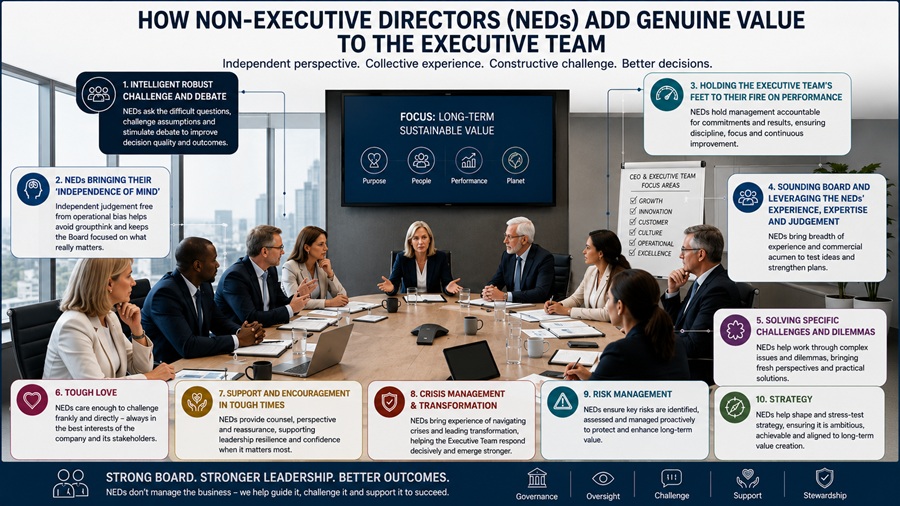
In my experience, here are the areas where Boards add significant value to their CEO & Executive Team;
Intelligent robust challenge and debate
At the end of the day, both an executive team and a board are defined by the success of the calls they make on major decisions. In my own board experience over the last 25 years, both as an executive and Chair/NED, combined with evaluating/supporting so many boards over the years, the chances of getting major decisions right are significantly enhanced by high-quality intelligent robust challenge and debate from NEDs who are extremely well prepared for board/committee meetings, who truly understand the organisation and who stretch the executive team to help optimise their thinking. It is always inspiring to see a group of NEDs and an executive team wrestle in the mud, have a spirited give and take, be comfortable to “enter the zone of un-comfortable debate”, face up to “the elephants in the room” with an overriding focus on “how do we make the best decision for the company?”. In the challenging environment that boards and executive teams are facing, this has never been more important.
NEDs bringing their “independence of mind”
One of the most powerful value-add that NEDs bring to the table is their “independence of mind” and their ability to help an executive team “see the wood for the trees”. Even the best battle-hardened executive teams can lose their objectivity on assessing a key situation, slide into “hope-is-a-strategy-mode” and start “flogging a dead horse” as they have simply become too close to a situation. NEDs who are not in the machine hour-to-hour, day-today, can bring an immensely valuable level of objectivity, sometimes cold and brutal, that can jolt an executive team in a positive way to both accept that current approaches are not working and that a Plan B is needed.
Holding the Executive Team’s feet to their fire on their performance
If there is one thing I have learned in my 35 year professional career is that every team needs their feet held to the fire in terms of their performance and accountability to deliver on what they had committed to. The best executive teams I have seen in action over the years absolutely thrive on the board holding them to the highest levels of accountability. This healthy tension and the consequences of poor performance are a vital component of the board – executive team engagement model. This is particularly evident in strong teams who for example after a poor quarterly performance, move heaven and earth to recover in the next quarter, driven by both their own professional pride and calibre but also in terms of honouring the commitments they made to the board.
Sounding board and leveraging the NEDs’ experience, expertise and judgement
The overwhelming majority of NEDs were previously executives themselves and together with their experience of serving in multiple organisations as executives and NEDs, they bring a wealth of experience, expertise, “scars on their backs and knees”, intuition and judgement that are invaluable to the executive team. In some cases, you have sector-expert NEDs who have spent 20 to 30 years in a particular sector and in the case of generalist-NEDs you have a fountain of experience across multiple sectors. Both at the board/committee meetings and in between board/committee meetings, this enables the executives to leverage an incredible bank of experience, knowledge and wisdom. While executives understand that they ultimately have to make their own calls and that the NEDs can also be wrong or mis-guided in their assessment, this sounding board adds significant value.
Solving specific challenges and dilemmas
There are times when an executive team has their backs to the wall in grappling with a major challenge or dilemma that could either be of their own making or which is caused by external events beyond their control. In all these cases, NEDs can bring incredible value to the executive team. Sometimes, an NED may find the “key to the puzzle” and in other cases, the discussions and brainstorming ultimately help the executive team to find the right path. This is also a compelling case for board diversity where a range of different thinking styles and approaches such as contrarian, devil’s advocate, left-field and blue-sky thinking help bring fresh ideas to the table and un-lock complex dilemmas.
The powerful value of “Tough love” in the boardroom
Over the years as I have observed boards and executive teams engage with each other, the very best NEDs have a great ability to;
* Ask difficult questions respectfully
* Push for clarity and evidence
* Challenge optimism bias
* Encourage long-term thinking
* Hold CEOs accountable privately and professionally
* Support management publicly once decisions are made
Bring calm judgement during pressure situations
Many CEOs and executives have shared with me over the years that some of the greatest value NEDs have added is when they have delivered “tough love” to the executive team for the very best of reasons and ultimately to help them. In the majority of cases the executives weren’t welcoming this tough love with open arms but deep down realised that the NEDs were doing what great NEDs should be doing and have only one objective, to help them. I find that executives are far more receptive when NEDs understand the organisation deeply, avoid public grandstanding, challenge ideas rather than personalities and combine scrutiny with encouragement. This goes to the very heart of the high-trust/high-challenge ethos of the best boards and executive teams which creates an environment where executives feel supported but accountable, difficult conversations happen early and major decision-making processes are highly rigorous and robust.
Support and encouragement in tough times
There are times when an executive team are genuinely on their knees, struggling, stressed and what they desperately need from the NEDs is empathy, encouragement and support at a human level. They heard it loud and clear in terms of the board’s disappointment/frustration/impatience on the particular area. There are situations where an executive team can lose its confidence after some missteps or be facing serious headwinds not of their own making. What they need at these moments from the Chair and NEDs is genuine empathy, encouragement, understanding and genuine words from the board that they believe in the executive team, acknowledge and appreciate the huge efforts they are making and are deeply committed to supporting the executive team. Sometimes, this is done at the boardroom table and sometimes it is done quietly between the Chair and CEO or between the CEO and the NEDs.
Crisis Management and Transformation
When an executive team is “in the eye of a storm”, experienced NEDs bring calm judgement and pattern recognition from prior crises. Whether the crisis is dealing with a litigation/regulatory investigation, a major cyber-incident, sudden CEO transition or economic downturn, experienced NEDs bring cool heads and wisdom to help an executive team successfully navigate through the storm. There is an incredible power to seeing an executive team and board “truly in the board together” and partnering brilliantly together to successfully steer through the crisis.
Risk Management
An exceptional CEO once said to me that “executive teams are not naturally good at risk management as we are intrinsically optimistic, growth oriented, overly ambitious and not good at looking around dark corners”. In the incredibly volatile un-predictable landscape that every organisation is operating in, NEDs have an absolute vital role in helping the executive team identify and face up to new risks, avoid blind-spots and significantly improve risk mitigation. In a recent board workshop, I highlighted this increasingly important role of the NEDs acting like a lighthouse to help illuminate the rocks in the stormy waters that the executive team struggle to see.
Strategy
Strategy has never been more difficult for executive teams to develop. The idea of a static 3-year strategy that doesn’t need to evolve over its lifetime is long-gone. Progressive executive teams enable a highly collaborative model with their NEDs whereby they stretch the NEDs to add serious value
to the strategy process in terms of exceptional intelligent challenge on the core assumptions/risks as well as encourage the NEDs to bring new thinking, sometimes radical, to the table. I still see executive teams who are incredibly poor at leveraging highly-experienced NEDs who have a lot of value to contribute in the strategy area. How an executive team collaborates with their NEDs in the strategy area is becoming a defining characteristic of the boards and executive teams who will successfully navigate the stormy waters of disruption, geo-political headwinds, new business models and technology innovation such as AI.
Summary
High-performing boards have a great ability to combine intelligent robust challenge, oversight and holding an executive team to account with adding incredible value to the executive team and helping them to excel. This value ranges from leveraging the “independence of mind” of the NEDs to helping solve tough challenges to genuine encouragement and support during tough times to high-value support on the strategy process. An interesting litmus test for the true value NEDs add to an executive team is to have an exit poll at the end of the board/committee meetings and to ask the executive team to answer the three questions of “Did this board/committee meeting add value today to you, how committed are the NEDs to supporting you and taking everything into account, do the NEDs make you and the executive team better?”
By Kieran Moynihan, Managing Partner - Board Excellence