- Ireland’s energy future discussed at William Fry’s Energy & Infrastructure Summit
- 71% of attendees believe Ireland should explore nuclear activity
- Three-quarters of attendees identified energy security as the leading priority for Government, ahead of affordability and decarbonisation
The William Fry Energy & Infrastructure Summit took place this morning at the College Green Hotel in Dublin, bringing together over 200 senior leaders from across the energy, infrastructure and technology sectors. Discussions centred on Ireland’s future energy needs, the acceleration of infrastructure delivery in the country and what can be done to maintain competitiveness in a rapidly changing global landscape.
Attendees heard from key voices across the energy sector, including fireside chats with Climate Minister Darragh O’Brien, John Fingleton CBE of the UK Nuclear Regulatory Taskforce, and Seán Sweeney, Programme Director for MetroLink, alongside two panel sessions offering different perspectives on Ireland’s infrastructure, policy environment and long‑term transition pathway.
Addressing the Summit, the Minister for Climate, Energy and the Environment, Darragh O'Brien, highlighted the scale of Ireland’s energy infrastructure requirements to sustain the next phase of economic growth.
He said: "Energy infrastructure is economic infrastructure. Countries that deliver reliable, affordable, decarbonised energy will attract high-value investment and skilled jobs. Ireland has the renewable resources, the capital investment, and a clear strategic roadmap. This Government is now focused on urgent, large-scale delivery - accelerating the build-out of our energy infrastructure so it becomes a powerful competitive advantage for our economy.”
John Fingleton discussed the evolving role of nuclear generation, and the lessons Ireland can draw from the UK’s experience. He noted: “If Ireland ever decides to embrace nuclear energy, it has the chance to learn from what the UK has got wrong in terms of poor regulation.”
Fingleton continued: “This is an exciting time to look again at nuclear energy. It has become increasingly safe. And there are new technologies emerging that will enable small modular reactors closer to where power is needed. If better regulation and economies of scale bring down the cost of nuclear power, it may be even more attractive as part of a low carbon energy mix. Ireland may wish to start to build institutional capacity in this area so as to have greater options going forward if and when nuclear becomes more attractive.”
Delegates participated in three live polls throughout the morning, with the results offering a real‑time snapshot of industry sentiment:
- 71% of attendees believe Ireland should explore nuclear activity
- 76% of respondents reported being “not confident” or “very concerned” about Ireland’s ability to deliver the energy infrastructure required for economic growth.
- Energy security was identified as the leading priority for Government to 2030 (75%), ahead of decarbonisation (7%) and affordability (18%).
- 73% cited the planning system as the single largest barrier to major infrastructure delivery.
Industry Leaders Outline Current Issues and Prospective Solutions
Two separate panel discussions provided industry experts and leaders with the platform to discuss an array of issues.
The first explored the planning environment around Ireland’s infrastructure and the policy framework that applies to the data centre sector. This discussion addressed many key stakeholder concerns including:
- The urgency around planning timelines;
- The integration of data centre energy requirements with national policy; and
- The capacity of Ireland’s infrastructure system to deliver major projects and the cultural and institutional changes required to accelerate progress.
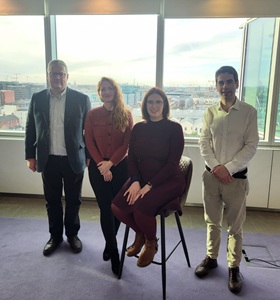
This expert panel included Richard Scannell, Head of Public Policy, Amazon Web Services (AWS); Vanessa O’Connell, Project Director for Dublin Array Offshore Wind Farm, RWE; Eamon Booth, Accelerating Infrastructure Taskforce; and Liam Kenny, CEO, John Paul Construction.
The second panel, titled “The Future of Energy in Ireland”, examined Ireland’s long‑term energy security, renewable generation and transition pathways, with insightful commentary from Liam Ryan, Chief Transformation Officer, EirGrid; Feargal O’Rourke, Chair of IDA Ireland; Paul Lennon, Head of Offshore Wind, Hydrogen and Long‑Duration Storage, ESB; and Fergus Devine, Partner & Head of Energy at William Fry.
Fergus Devine, Partner & Head of Energy at William Fry, noted that: “The Irish energy industry and the Irish economy more broadly are at an inflection point. There is a huge demand for all forms of energy, renewable and dispatchable, to power the industries that will drive economic growth and support Ireland’s growing population. The projects are waiting and can be executed and the political will to facilitate energy infrastructure is apparent. What the country needs now is to build on the momentum of the CRU’s LEU Decision and the Government’s Large Energy User Action Plan and ensure that the generation and the demand to power that economic growth are prioritised and delivered.”
Feargal O’Rourke, Chair of IDA, emphasised the importance of delivery, noting: “Multinationals are no longer asking ‘Can Ireland deliver?’. They're asking, ‘Will Ireland deliver consistently and on time?’ The Accelerating Infrastructure Taskforce is a positive signal but it must drive measurable action. Our competitiveness now rests on execution.”
Vanessa O’Connell, Project Director for Dublin Array Offshore Wind Farm, spoke about some of the challenges to delivering offshore energy success. She said: “The Dublin Array project is progressing, but port facilities are not yet optimised for offshore wind installation. That adds cost and extends timelines. If Ireland wants 30–35 GW of offshore wind by 2050, we need to upgrade port infrastructure, develop supply chain capabilities and invest in the logistics ecosystem. That's not just a project issue; it's a national strategic question.”